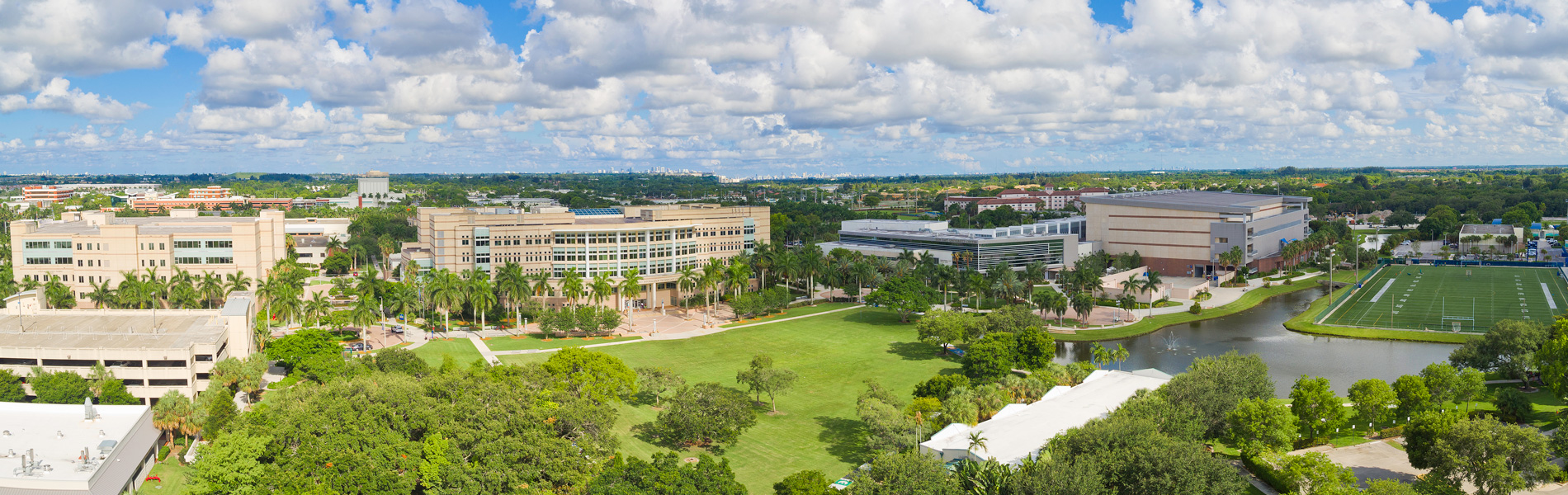
Welcome to NSU's Office of Financial Aid
Whether you're starting your first degree or advancing your career, explore financial aid resources tailored to your program level. Learn about scholarships, grants, loans, and more—so you can focus on your future without the financial stress.
Find Financial Aid for Your Path
One-on-One Support
Have questions or need guidance? Our Financial Aid team is available to help you understand your options and complete the financial aid process.
Call Us
(954) 262-3380 or 800-806-3680
Stop By
Horvitz Administration Building
3300 S. University Drive
Fort Lauderdale, FL 33328-2004
Monday–Friday: 8:30 a.m.–5:00 p.m.
Send Us an Email
finaid@nova.edu
Understanding the Financial Aid Process
Begin your financial aid journey by filing the FAFSA, checking your status, or following NSU’s eight-step aid process.
Understanding Your Financial Aid Options


NSU FastChoice
FastChoice provides private loan options for every student including undergraduate, graduate, healthcare, business, law, and parents. FastChoice helps you request the loan you determine is right for you by providing detailed information for various loans, as well as the terms and benefits offered by different lenders. NSU maintains both Preferred Lender lists and a list of private lenders that have been utilized historically by NSU students.
NSU encourages students to maximize their federal loan eligibility before utilizing private student loans for their educational expenses.
Students may view current federal grant and loan maximums, eligibility requirements, and applicable annual and aggregate limits on our website:
Find Financial Aid Resources Tailored to You
Every Shark’s journey is different. From first-year undergraduates to advanced professionals and veterans, NSU offers tailored financial aid support to help you navigate your next steps.




Net Price Calculator
Curious about undergraduate costs? Use the Net Price Calculator to estimate the cost of attending NSU for bachelor’s degree programs after scholarships and financial aid.

Updates and Announcements
Complete your FAFSA to be considered for federal, state, and university financial aid. The earlier you apply, the more options you’ll have.
The NSU Federal School Code: 001509
On July 4, 2025, the One Big Beautiful Bill Act was signed into law, introducing significant updates to the Federal Student Aid (FSA) program. These changes will take effect July 1, 2026, and are designed to simplify and streamline how students and families apply for and receive aid.
For a detailed overview of these updates, view the official Federal Student Aid Changes Chart (PDF) compiled by the National Association of Student Financial Aid Administrators (NASFAA).
Additional Resources
All institutional charges, such as tuition, fees, and housing, if applicable, must be paid in full or satisfied with payment arrangements by the published deadlines.
Undergraduate students who do not have their payment or payment arrangements finalized will have their class registration canceled.
Payment arrangements include any one or more of the following, as applicable:
- awarded financial aid, including grants, scholarships, and Federal Direct Loans (including Subsidized, Unsubsidized, and Parent PLUS loans)
- cash, check, credit card, money order, or electronic transfers
- certified alternative/private loans
- Florida Prepaid funds
- Other third-party payments
- Tuition waivers
- Federal and state educational funding programs
- Veterans and GI Bill® benefits
- finalized NSU payment plan
We encourage all NSU Sharks to take action on financial aid requirements promptly and to make arrangements for payment by the deadline.
Policy and Deadlines Student Accounts and Financial Aid Next Steps
Disclaimer: The information on this site is provided for general guidance only. Information may change to reflect NSU's compliance with current institutional policy or federal and state laws and regulations that guide the financial aid industry.
Types of Aid


Tools and Resources

Find verification forms, appeals, special circumstance requests, and other documents
you may need to complete your financial aid file.Forms and Documents

Stay up to date on deadlines, policy updates, reminders, and financial aid tips. Dollars and Sense Newsletter

Get a personalized estimate of your NSU costs after scholarships, grants, and aid.Net Price Calculator
Graduate and Professional FAQ
Students should apply as soon as possible after the FAFSA becomes available on October 1 for aid in the following academic year at studentaid.gov.
Your financial aid package may include the following types of aid:
Check out our Sources of Aid brochure for a quick overview.
The best place to check on your financial aid for a real-time status is your secure SharkLink account. Your financial aid widget will display if you have any additional requirements to complete and when your financial aid offer is available for your review.
Yes. You must submit a new FAFSA for each academic year at studentaid.gov.
To be eligible for federal financial aid, students must meet the following requirements.
- Be a U.S. citizen or eligible noncitizen
- Have a valid Social Security number
- Be enrolled or accepted for enrollment as a regular student in an eligible degree or certificate program
- Be enrolled at least half-time in degree-applicable coursework to be eligible for Direct Loan Program funds
- Provide consent and approval to have your federal tax information transferred directly into your Free Application for Federal Student Aid (FAFSA®)
- Sign the certification statement on the FAFSA stating that
- you are not in default on a federal student loan and do not owe money on a federal student grant
- Show you are qualified to obtain a college education by
- having a high school diploma or a state-recognized equivalent such as a General Educational Development (GED) certificate.
- completing a high school education in a homeschool setting approved under state law (or—if state law does not require a homeschooled student to obtain a completion credential—completing a high school education in a homeschool setting that qualifies as an exemption from compulsory attendance requirements under state law).
- Maintain satisfactory academic progress toward a degree or certificate in an eligible program
For more details, visit our Financial Aid Eligibility page.
Currently, there are two primary federal graduate lending programs: the Federal Direct Graduate PLUS program (Grad PLUS) and the Federal Direct Unsubsidized Loan program. As of July 1, 2026, the Grad PLUS program will no longer be available to new borrowers. The Federal Direct Unsubsidized Loan program is introducing new annual and aggregate (lifetime) borrowing limits. There is also a new total lifetime limit across all loans of $257,500. Finally, students who enroll for less than full-time will have a proportionate reduction in the amount they can borrow.
For graduate non-professional degrees, the new caps are:
- $20,500 annually; and
- $100,000
For graduate professional degrees, the new caps are:
- $50,000 annually; and
- $200,000 aggregate.
In addition, there is a new total lifetime limit across all loans of $257,500.
The following NSU programs qualify for the professional program caps listed above:
- Doctor of Osteopathic Medicine (D.O.)
- Doctor of Allopathic Medicine (M.D.)
- Doctor of Optometry (O.D.)
- Doctor of Dental Medicine (D.M.D)
- Doctor of Pharmacy (Pharm.D.)
- Doctor in Clinical Psychology (Psy.D.)
- Doctor in Clinical Psychology (Ph.D.)
- Doctor in School Psychology (Psy.D.)
- Law (J.D.)
- Specialist in School Psychology (Psy.S.)
The definition of “professional” program is currently subject to an ongoing court case. On June 24, 2026, the court issued a temporary stay affecting the Department of Education’s (ED) definition of eligible professional programs. In response, ED issued temporary guidance identifying additional programs that may qualify for the higher professional loan limits while the stay remains in effect.
To view the list of programs, please refer to ED’s guidance, GENERAL-26-42, “Update to List of Professional Programs Due to Court Order,” and studentaid.gov.
The Graduate PLUS Loan program is being phased out. Beginning July 1, 2026, it will no longer be available to new borrowers. Current borrowers (those who have a Federal Direct Loan disbursed prior to July 1, 2026) who stay in their program at NSU can keep borrowing under current rules for up to three more academic years or their remaining expected time to credential, whichever comes first. These borrowers are referred to as “grandfathered” borrowers.
The annual and aggregate loan limits are published in the 2026–27 Terms and Conditions of Your Financial Aid Award.
Beginning July 1, 2026, annual loan amounts will be prorated in direct proportion to the student’s enrollment. For example, a student enrolled at 3/4 of full-time will be able to borrow a maximum of 3/4 of the loan limit for the program and credential level. As a result, an annual loan limit of $20,500 would become a loan limit of $15,375.
Undergraduate FAQ
Students should apply as soon as possible after the FAFSA becomes available on October 1 for aid in the following academic year at studentaid.gov.
Your financial aid package may include the following types of aid:
Check out our Sources of Aid brochure for a quick overview.
The best place to check on your financial aid for a real-time status is your secure SharkLink account. Your financial aid widget will display if you have any additional requirements to complete and when your financial aid offer is available for your review.
Yes. You must submit a new FAFSA annually which becomes available October 1 at https://studentaid.gov/.
How much financial aid you can receive at Nova Southeastern University depends on several factors. Generally, your eligibility depends on your Student Aid Index (SAI), your year in school, your enrollment status, and your program’s cost of attendance (COA).
For more details, visit our Financial Aid Eligibility page.
No. There are no major changes to undergraduate student borrowing programs.
Yes. As of July 1, 2026, parents will be permitted to borrow up to $20,000 per year per child and $65,000 lifetime per child. These limits apply to all parents of a student, so the maximum amount a student may receive in a year is $20,000, and across all years is $65,000, regardless of whether one or more parents are borrowing on their behalf. This is a change from current law, which allows parents to borrow up to the full cost of attendance per child.
Scholarships and grants typically require full-time enrollment, which is a minimum of 12 credits per semester. Beginning July 1, 2026, students who are enrolled less than full-time, will have a proportionate reduction in the amount they can borrow. For example, a student enrolled at 3/4 of full-time (e.g., 9 credits) will be able to borrow a maximum of 3/4 of the loan limit for the program and credential level. As a result, an annual loan limit of $5,500 for first year students would become a loan limit of $4,125.
The bill contains two eligibility changes: the elimination of Pell Grant eligibility for 1) students receiving scholarships that meet or exceed their full cost of attendance, and for 2) students whose Student Aid Index (SAI) is at least two times the current Pell Grant maximum of $7,395. As of FY25, that equates to an SAI of $14,790.
Every student, athlete or not, who receives a full-ride scholarship that meets or exceeds their COA will lose access to Pell Grants for the terms they receive the scholarship. Their lifetime Pell Grant eligibility will also be reduced by an equivalent amount.